
The Lost Key to Unity

Updated: Apr 15
Bridging the Divide Between Thomas and the Gospel of Christ

A Radical Invitation to Common Ground
We often speak of faith as something that divides us. Labels like "Christian," "Gnostic," or "Seeker" can feel like high walls. But what if there was a single, ancient thread of wisdom that connected them all? A thread that was, perhaps, too revolutionary to be contained within any single institution?
In 1945, the desert sands of Egypt yielded a stunning secret: the Nag Hammadi Library, containing the Gospel of Thomas. This isn’t a story of Jesus’s life; it’s a collection of 114 enigmatic sayings. Some labeled it "heretical," while others saw it as the preservation of Jesus's most esoteric, internal teachings.
Whether you are a devoted Christian, a mystical seeker, or an agnostic looking for depth, the central question of Thomas belongs to you. This blog post isn’t about replacing one doctrine with another. It’s about building a bridge. It’s about discovering how a single ancient statement, Saying 22, can help us all, regardless of our path, find the unity we are desperately searching for.
Understanding the Essence of Unity
Unity is not just a concept; it is a profound experience. It invites us to look beyond our differences. It encourages us to embrace the shared human experience. When we seek unity, we open ourselves to deeper connections. We begin to see that our journeys, while unique, are intertwined.
The Gospel of Thomas offers a unique perspective on this unity. It challenges us to reconsider our beliefs. It asks us to explore the deeper meanings behind our faith. This exploration can lead to profound insights and personal growth.
Thomas’ Paradox of Wholeness
The text itself is a riddle of non-dual consciousness:
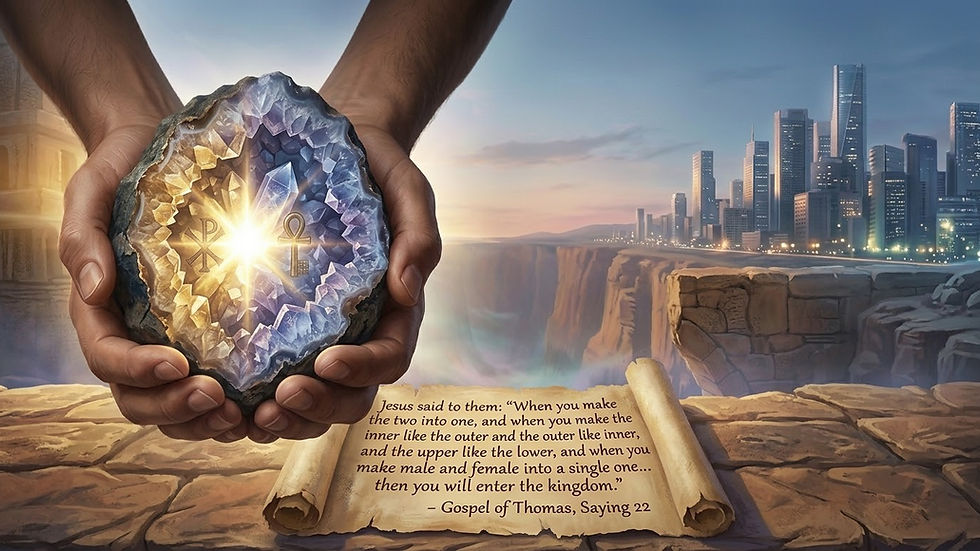
Jesus saw some infants who were nursing. He said to his disciples, "These infants who are nursing are like those who enter the kingdom." They said to him, "Then shall we enter the kingdom as infants?" Jesus said to them, "When you make the two into one, and when you make the inner like the outer and the outer like the inner, and the upper like the lower, and when you make male and female into a single one... then you will enter [the kingdom]."
Translating the Riddle
At first glance, this sounds like a cryptic paradox. But for centuries, thinkers across traditions have wrestled with the same truth: we are divided, and we long to be whole.
A Christian might read this through the lens of sanctification—the lifelong process of allowing Christ to align our internal character (The Inner) with our external actions (The Outer). They would recall Jesus’s teaching that the "Kingdom of God is within you" (Luke 17:21), a profound echo of the Gnostic principle.
A Gnostic would see this as Gnosis itself—the definition of a reality where the Divine Spark within is realized as the ultimate truth, and the separation between "God" and "self" collapses.
Step onto the Bridge
This is the bridge: The goal is the same—Unity with the Divine. One path describes this as a relationship with an external Savior who reconciles us; the other as an internal "remembering" of our inherent connection. Thomas’s Jesus invites us to step beyond the language of division and focus on the universal experience of internal integration.

Ending the Internal Civil War
Saying 22 is an explosive challenge. It demands that we cease being "a house divided against itself."
The Inner and the Outer: Where are we one person on Sundays and another on Mondays? Where does our outward performance hide our internal vulnerability?
The Upper and the Lower: We are not called to be "too heavenly minded to be of any earthly good." The Gnostic goal is grounded wisdom—spirit and earth unified.
Male and Female as One: This isn't about ignoring gender but integrating our internal energies—our strength (masculine) and our intuition (feminine)—into a balanced, powerful whole. This is the integration that Christian mystics often described as "spiritual marriage."
In the Gnostic view, salvation is the act of overcoming the "Two" (the feeling of separation) and becoming the "One" (Unified Consciousness). For a Christian, it is finding complete oneness in Christ (John 17:21). The destination is a single, unified consciousness that knows only love and connection.

The Gospel of Thomas isn’t a threat to faith; it is a catalyst for contemplation. It calls us from our comfort zones and asks us to do the internal work that transcends any label. You don’t have to "believe" a creed to sit with Saying 22. You only need the courage to look at your own divisions.
Are you ready to stop the "War Within"? Are you living authentically, making the outer match your inner truth? Are you divided within yourself, and how can you begin the work of reconciliation or integration?
The Path to Personal Empowerment
This journey is too important to walk alone. To help you move from reading about unity to experiencing it, I have created the Unity Bundle—a dual-resource gift to guide your transformation:
The War Within: A Contemplative Guide to Inner Unity – A premium, 8-page digital workbook featuring deep reflection prompts, guided meditations, and practical tools to balance your energies.
Gnosis & The Gospel: A Bridge for Contemplation – A specialized comparison worksheet designed to help you navigate the shared "deep truths" between the Gospel of Thomas and the Canonical Gospels.
The key was buried for centuries, but it has been found. And it belongs to you. Download your FREE Unity Bundle at the link below and join the conversation. Which part of Saying 22 offers the biggest bridge for you?


Comments